原文来自清华大学电子工程系:
https://mp.weixin.qq.com/s/EDONxB8rDqvrUiPIy9AWYg
The research group led by Professor Lu Fang from the Department of Electronic Engineering at Tsinghua University has proposed a photonic deep learning architecture and chip. This breakthrough overcomes the long-standing challenge of error accumulation in deep optical computing, achieving for the first time a hundred-layer, hundred-million-parameter deep photonic neural network.
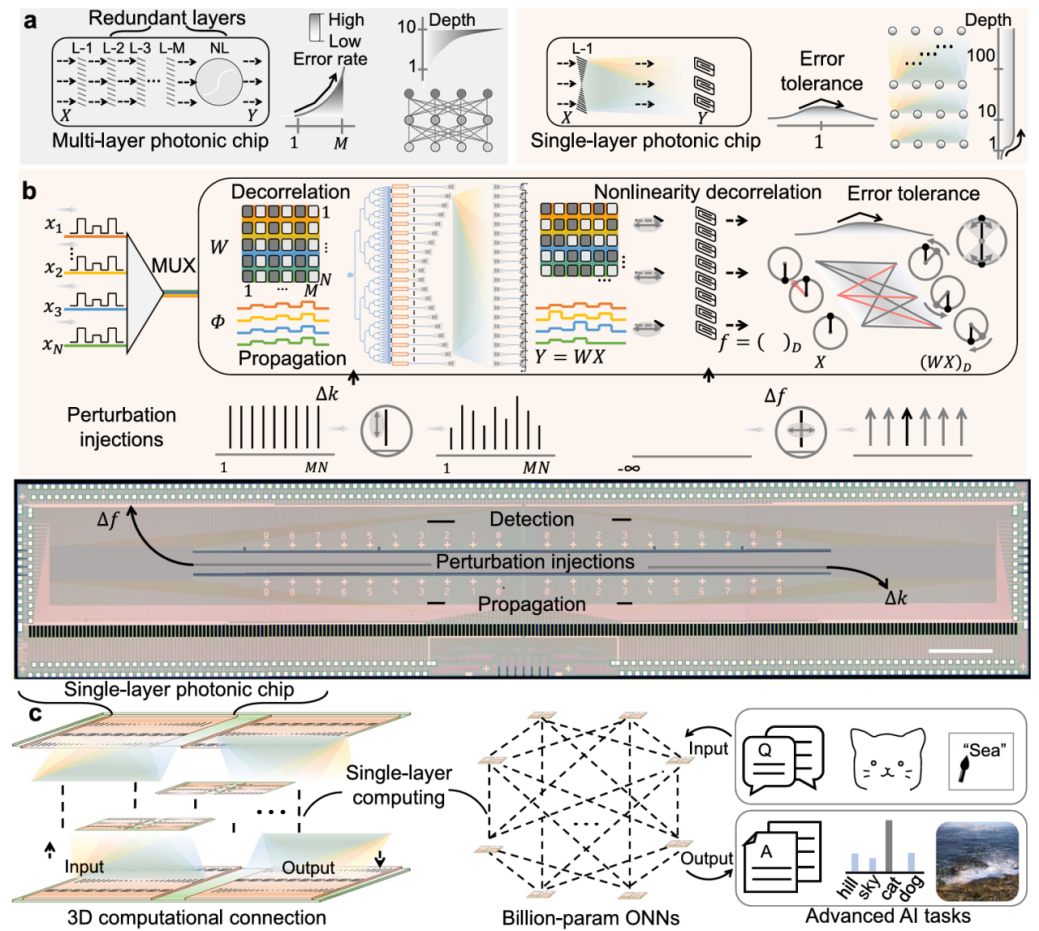
Figure 1. Photonic deep learning computing architecture and chip
The demand for computing power in artificial intelligence development is growing at a rate far exceeding Moore's Law. Optical computing, which uses photons as information carriers and performs computation through controlled light propagation, offers outstanding advantages in computing power and energy efficiency. However, optical computing has long faced the problem of numerical errors being rapidly amplified during deep propagation, making it difficult to support large-scale deep computation.
This study characterizes the propagation redundancy of on-chip photonic neural networks, establishes a quantifiable error propagation model, and proposes a cascadable single-layer light computation (SLiM) architecture. Leveraging the bandwidth advantage of light propagation, the team designed a spatial-spectral coupled computing chip architecture that expands the on-chip single-path optical information throughput to 256 channels, achieving THz-level bandwidth per optical computing path. An on-chip active injection perturbation structure is built to break the inherent wavelength correlation constraints of optical paths, enabling arbitrary-scale and arbitrary-dimensional matrix computation within the information throughput using only a single layer of propagation. To address the challenge of deep cascading, an interlayer detection perturbation nonlinear activation mechanism is proposed, physically cutting the chain of error accumulation. The organic integration of arbitrary matrix mapping capability with deep cascading mechanisms further supports the flexible construction of computational units such as convolutional kernel transforms and attention operators. As a result, the physical propagation layers and nonlinear layers in deep photonic neural networks are compressed into a single light propagation and detection activation step, maintaining the speed and scale advantages of optical computing while effectively suppressing model error accumulation.
Based on the SLiM architecture and chip, the team constructed a 100-layer photonic deep network and achieved classification on the full ImageNet-1000 dataset with 85.2% accuracy. Furthermore, they realized 384-layer and 640-layer Transformer photonic large models with parameter scales of 0.345 B and 0.192 B, supporting text generation and image generation, as shown in Figure 2.
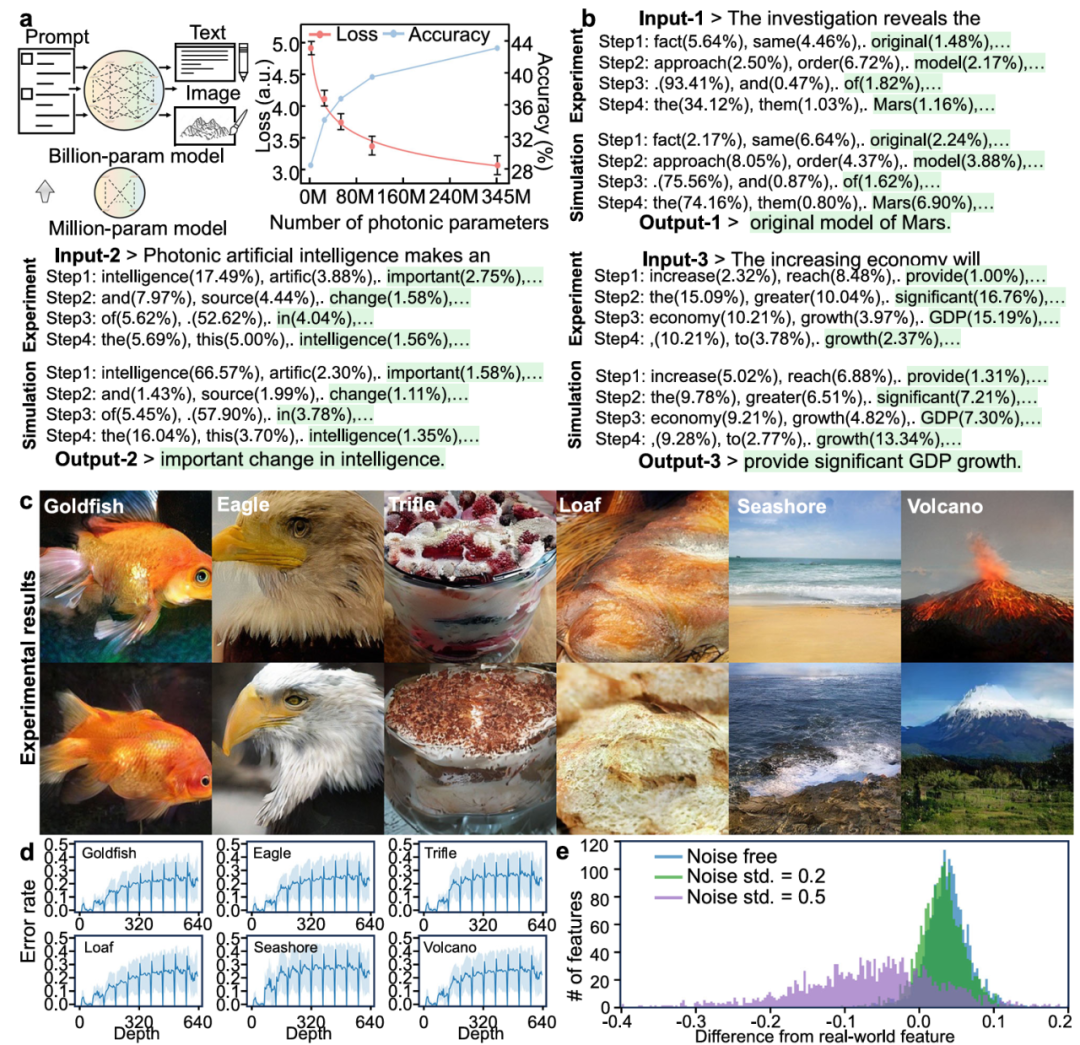
Figure 2. Photonic large model computing
This work overcomes error accumulation, a core bottleneck that has long plagued deep optical computing. It proposes an optical computing mechanism that can physically suppress deep error propagation and implements a new architecture for deep photonic neural networks scalable to hundreds of layers, exploring an effective path for layer expansion in optical computing. This achievement is expected to provide photonic computing power for future large-scale AI models and complex intelligent tasks. The related research was published in Nature Communications under the title "Hundred-layer photonic deep learning." Tiankuang Zhou, a postdoctoral fellow, and Yizhou Jiang, a Ph.D. student in the Department of Electronic Engineering at Tsinghua University, are co-first authors. Professor Lu Fang is the corresponding author. The research was supported by major projects of the Ministry of Science and Technology, the National Science Fund for Distinguished Young Scholars, and the Young Elite Scientist Sponsorship Program of the China Association for Science and Technology.

Paper link: https://www.nature.com/articles/s41467-024-52418-y