本文来自清华大学电子工程系:
https://mp.weixin.qq.com/s/QmBNGoIfH1LKz4bz0y0EnQ
High-resolution mapping of massive neuronal signals is a key goal and major direction for next-generation brain-computer interface technology. Electrocorticography (ECoG) devices, which are placed on the cerebral cortex, can monitor the coordinated activity of neural populations over large areas and have been successfully used in critical scenarios such as speech synthesis, movement decoding, and epileptic focus localization. However, conventional passive ECoG electrodes are typically millimeter-sized, much larger than the functional cortical columns (tens to hundreds of micrometers), making it difficult to precisely capture neural signals from sub-regions. Moreover, high-resolution recording relies on high-density electrode arrays, but each channel of passive electrodes requires an independent wire, severely limiting array size and signal readout. Overcoming the core bottlenecks of flexible ECoG devices—such as low channel count, low density, complex wiring, and difficulty in mass production—to achieve high-spatial-resolution recording of large-area brain signals has become a critical scientific problem and major engineering challenge.
Recently, a research group led by Xing Sheng from the Department of Electronic Engineering at Tsinghua University, in collaboration with other researchers, developed a flexible, multiplexed, high-density ECoG brain-computer interface electrode array named NeuroCam, which features up to 4096 channels and is suitable for large-scale manufacturing. This breakthrough overcomes the key challenges of existing devices, including low channel count, low density, complex wiring, and difficulty in scalable fabrication, opening a new path for high-spatial-resolution recording of large-area brain signals.
The NeuroCam array is built on metal-oxide thin-film transistors (TFTs), integrating 4096 recording channels on a monolithic flexible substrate with a channel density of 44 sites/mm⟡. Through multiplexing design, signal readout requires only 128 input/output lines, effectively solving the wiring problem of high-channel devices. Additionally, the device uses industrial-scale manufacturing processes, ensuring both the feasibility of mass production and consistency of performance across channels.
In in vivo experiments with an epileptic animal model, NeuroCam could simultaneously and precisely capture the spatiotemporal evolution of epileptic potentials in real time with 4096 channels and clearly localize the seizure focus, demonstrating excellent spatial resolution and large-area brain recording capability. Furthermore, in vitro experiments validated key performance metrics such as biocompatibility, electrical stability, and bending resistance.
NeuroCam shows significant advantages in key metrics such as channel count and density, not only providing a new tool for analyzing complex neural activity and advancing high-performance brain-computer interface technology but also bringing new opportunities for neuroscience research and neural engineering applications related to the diagnosis and treatment of neurological disorders such as epilepsy.
The research findings were published on November 17 in Science Bulletin under the title "High-resolution spatial mapping of electrocorticographic activities with NeuroCam: a 4096-channel, multiplexed flexible thin-film transistor array" and were selected as the inside cover image.
Xing Sheng, Associate Professor in the Department of Electronic Engineering at Tsinghua University and the Tsinghua-IDG/McGovern Institute for Brain Science, and Guoguang Zhao, President of Xuanwu Hospital, Capital Medical University, are co-corresponding authors. Yang Xie, a 2024 Ph.D. graduate from the Department of Electronic Engineering at Tsinghua University, is the first author. The research was supported by the National Natural Science Foundation of China, among others.
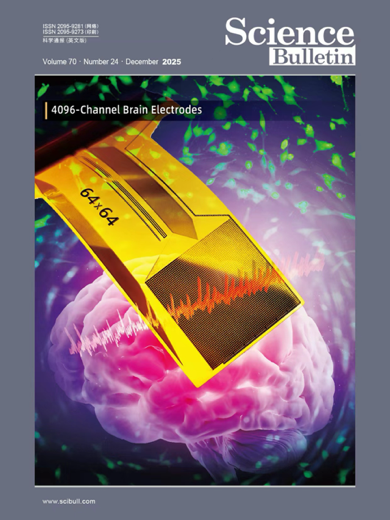
Science Bulletin inside cover
Paper information:
https://www.sciencedirect.com/science/article/pii/S2095927325011582