原文来自清华大学电子工程系:
https://mp.weixin.qq.com/s/CIvwM9kwQnNaVzyM54UVlw
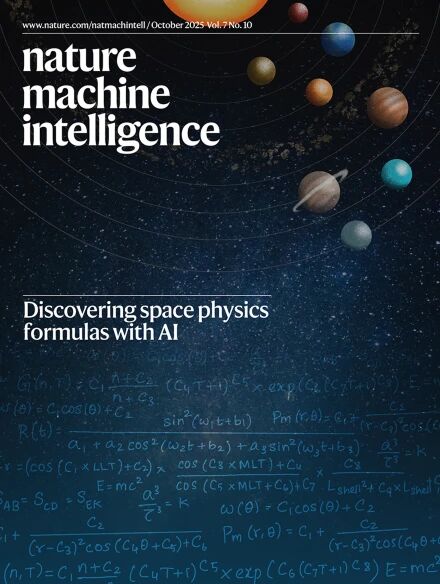
October cover of Nature Machine Intelligence: Discovering space physics formulas with AI
Discovering natural laws and revealing mathematical structures is a core pursuit of physical science. Traditional physical formulas often originate from long-term experimental accumulation and human insight. How to enable artificial intelligence to directly "induce" natural laws from observational data has become an important frontier in the interdisciplinary field of AI and basic sciences.
To address the bottlenecks of existing symbolic regression algorithms in interpretability and scalability, Yuan Zhou, Associate Professor at the Yau Mathematical Sciences Center of Tsinghua University, and Jianzhu Ma, Associate Professor at the Institute for AI Industry Research (AIR) and the Department of Electronic Engineering of Tsinghua University, collaborated to propose a neural-symbolic model that can automatically derive space physics formulas from observational data — PhyE2E (Physics End-to-End Symbolic Regression Framework). This framework combines large language models with physical knowledge to build an AI system capable of end-to-end generation, decomposition, and optimization of physical formulas, achieving important progress in AI-driven discovery of space physics formulas.
On October 15, the research findings were published in Nature Machine Intelligence under the title "A Neural Symbolic Model for Space Physics."
In this framework, mathematical analysis plays a core supporting role. The "formula decomposition module" proposed by the research team uses the second-derivative matrix (Hessian matrix) of neural networks to analyze nonlinear coupling relationships among variables. When the model detects that the second-order partial derivatives between certain variables are close to zero, it determines that they are independent in the physical law, thereby decomposing a complex equation into several sub-equations that can be solved independently. Through this mathematical mechanism, the model can automatically identify structural relationships among physical variables without relying on specific formula structures, significantly reducing search complexity and making the generated results more concise and physically meaningful.
In terms of overall design, PhyE2E integrates modules such as the Transformer architecture, generative large language model (LLM) data augmentation, Monte Carlo tree search (MCTS), and genetic algorithm (GA) refinement, achieving full-chain reasoning from experimental data to symbolic formulas. The model can not only generate equations with physical dimensional consistency, but also automatically identify structural relationships of formulas and produce mathematical forms that conform to physical laws. The study shows that PhyE2E significantly outperforms mainstream international methods in multiple metrics, including symbolic accuracy, fitting precision, and unit consistency, and achieves state-of-the-art performance on several real-world physics datasets.
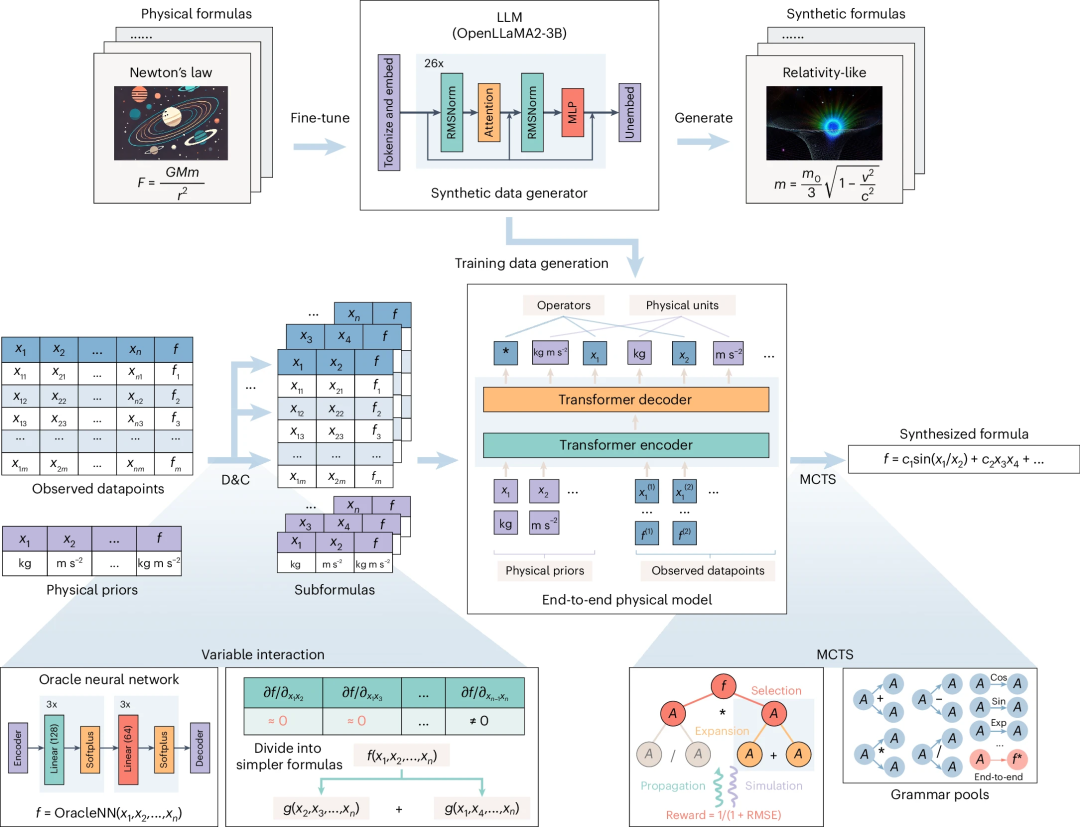 S
S
chematic diagram of the PhyE2E system
The research team applied the system to five important scenarios in space physics, including sunspot intensity prediction, solar rotation angular velocity calculation, emission line contribution function analysis, near-Earth plasma pressure monitoring, and lunar tide plasma signal research. The physical formulas generated by AI demonstrated extremely high accuracy in fitting experimental data from satellites and astronomical telescopes. The proposed formulas successfully overturned a solar activity formula proposed by NASA in 1993 and, for the first time, revealed the physical mechanism of long-period solar activity in an explicit form. Furthermore, the study found that the decay intensity of near-Earth plasma pressure is proportional to the square of the distance from Earth, and the mathematical derivation of this conclusion is highly consistent with satellite observation data from another independent study. The physical formulas derived by the system to describe the relationships among emission lines, temperature, electron density, and magnetic fields in the solar extreme ultraviolet spectrum also fully conform to the theoretical characteristics previously hypothesized by physicists.
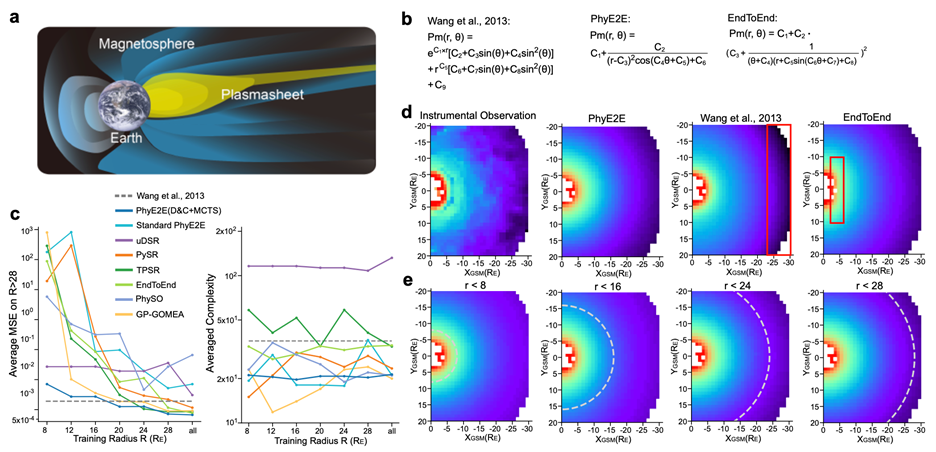
The research team applying PhyE2E to formal modeling of near-Earth plasma pressure
This work demonstrates the potential of AI in the full-chain modeling "from data to laws" and opens a new paradigm for AI-driven physics research. The core idea of PhyE2E lies in combining symbolic reasoning with data-driven learning, enabling AI to generate interpretable formulas with clear physical meaning, showcasing the limitless possibilities of AI in advancing scientific discovery. This research provides a powerful computational tool for space physics and offers a generalizable approach for discovering laws in broader scientific fields such as fluid dynamics and condensed matter physics.
Academician Shing-Tung Yau of the Yau Mathematical Sciences Center at Tsinghua University, Associate Professor Yuan Zhou of the same center, and Associate Professor Jianzhu Ma of the Institute for AI Industry Research (AIR) and the Department of Electronic Engineering at Tsinghua University are co-corresponding authors. Jie Ying, a Ph.D. student in the Class of 2024 at Qiuzhen College, Tsinghua University; Haowei Lin, a Ph.D. student in the Class of 2023 at the School of Intelligence Science and Technology, Peking University; and Chao Le, a researcher at the School of Earth and Space Sciences, Peking University, are co-first authors.
Paper link:
https://www.nature.com/articles/s42256-025-01126-3